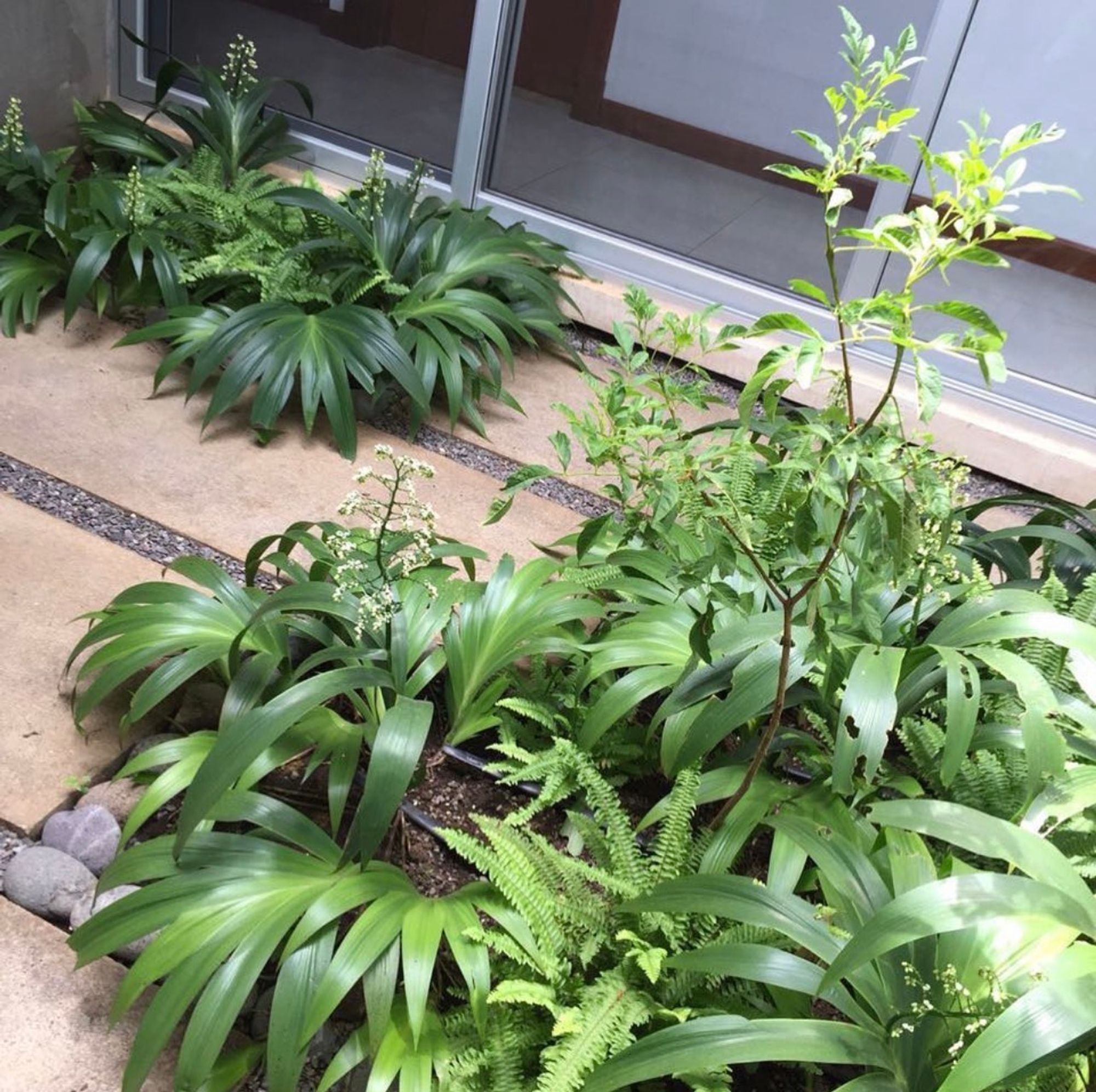
One of the biggest mistakes in tropical landscape design is assuming that tropical plants exist merely as decorative objects distributed across space according to aesthetic preference.
In reality, tropical vegetation follows highly complex ecological structures shaped by climate, humidity, light, succession, soil conditions and biological interactions that have evolved over millions of years.
Yet many contemporary tropical projects continue being designed almost exclusively through visual criteria.
Designers often focus on selecting species based on color, texture, size or immediate visual impact without fully understanding how those plants naturally organize themselves within ecosystems.
Some architecture firms working under permaculture principles attempt to source species from nearby ecosystems, which is already a significant step forward. However, I believe the real opportunity lies even deeper.
Instead of asking what plants are available for a project, we should first study how the local landscape itself is naturally structured.
The real creativity of tropical design does not necessarily come from constantly searching for exotic or rare species.
It comes from understanding composition.
How plants organize themselves naturally. How species overlap. How light moves through vegetation. How density changes spatial perception. How succession creates rhythm and transformation over time.
Tropical ecosystems already contain extraordinary design intelligence.
The challenge is learning how to interpret it.
Unfortunately, many tropical projects remain disconnected from that ecological logic.
This disconnect often leads to repetitive landscapes built from the same ornamental species copied from international trends or commercial nursery availability rather than from the biological reality of the site itself.
Costa Rica possesses an enormous floristic reservoir that remains deeply underexplored within architecture and landscape design.
In many cases, the limitation is not biodiversity itself, but rather the lack of horticultural knowledge required to propagate and work with these species properly.
When spaces are designed purely from aesthetics, they often become what I describe as “green deserts”.
Visually attractive environments that lack ecological function, biological relationships and long-term natural balance.
Meanwhile, nature constantly demonstrates how efficiently tropical systems can organize themselves with minimal intervention.
In places like Manzanillo, for example, many coastal ecosystems already behave like naturally balanced gardens.
Species such as Costus scaber develop compact forms near sea level due to temperature, humidity and light exposure, almost appearing intentionally pruned. Others, such as Hymenocallis littoralis, emerge naturally from displaced bulbs carried by sand and ocean currents, later producing spectacular blooms almost unexpectedly within the landscape.
These systems are aesthetically powerful precisely because they are functioning naturally.
Designing from biology instead of purely from architecture changes everything.
Suddenly the focus shifts toward understanding ecological interactions, floristic composition, environmental behavior and the way species sustain one another through complex biological networks.
Properly designed tropical systems usually require less maintenance, less aggressive pruning and fewer artificial corrections because the ecological structure itself becomes more stable over time.
Living in the Caribbean reinforced this understanding even further.
Growth rates, humidity and biological intensity completely transform how tropical spaces behave. Species that may take months to develop in cooler highland regions can become fully established within days under Caribbean conditions.
This changes planting strategies entirely.
In many tropical environments, allowing plants additional space to naturally develop often produces far better results than attempting to force immediate visual perfection through excessive density and constant maintenance.
To me, truly premium tropical design has very little to do with luxury aesthetics alone.
Premium means functionality.
It means understanding species deeply enough to create systems that work naturally, evolve correctly and fulfill their ecological and spatial roles with minimal intervention.
A premium landscape is one that delivers exactly what it promises.
If a tree is selected to attract wildlife, then wildlife should arrive. If a garden is designed to generate shade, biodiversity or ecological balance, those functions should emerge naturally through the system itself.
In many ways, Costa Rica already exists as one enormous tropical garden.
Perhaps the future of tropical design is not about controlling nature more aggressively, but about finally learning how to design alongside it.